Complexity
Science✶Hub
Quo vadis,
stochastic thermodynamics?
Jan Korbel
Complexity Science Hub
CCS 2026 satellite session
Thriving in the Extremes
The paper behind this talk
Complexity
Science✶Hub
✶
2
csh.ac.at ✶
Quo vadis, stochastic thermodynamics?
With my co-authors
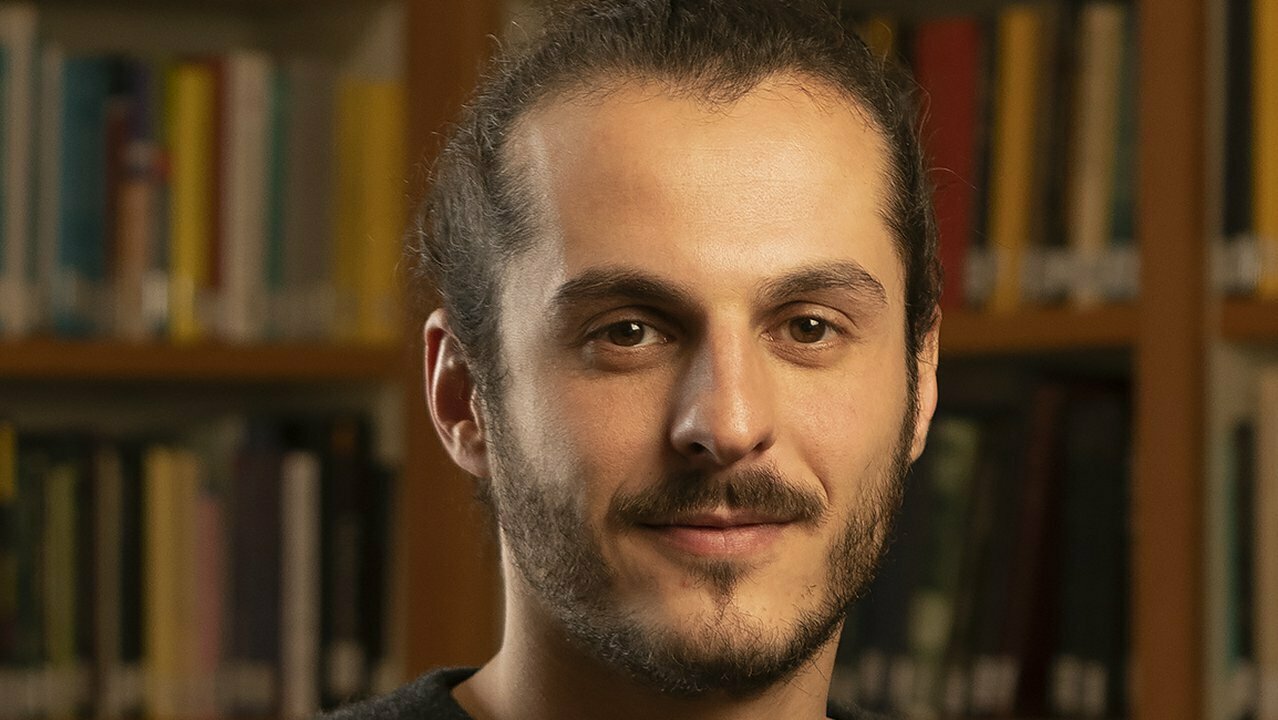
Artemy
Kolchinsky

Sarah A. M.
Loos

Gonzalo
Manzano

Rosalba
Garcia-Millan

Olga Movilla
Miangolarra

Édgar
Roldán
Journal of Non-Equilibrium Thermodynamics
doi.org/10.1515/jnet-2026-0051
Portraits: SFI, APS Physics, Google Scholar, King's College London, UC Irvine and ICTP public profiles.
Thirty years of stochastic thermodynamics
Complexity
Science✶Hub
✶
3
csh.ac.at ✶
1990s
Foundations
• Stochastic energetics
• Fluctuation theorems
• Jarzynski–Crooks relations
2000s
Trajectory theory
• Entropy production
• Information thermodynamics
• Feedback and response
2010s
Universal bounds
• Uncertainty relations
• Speed-limit theorems
• First-passage statistics
Today
New regimes
• Hidden variables & memory
• Active & interacting matter
• Optimal transport & scaling
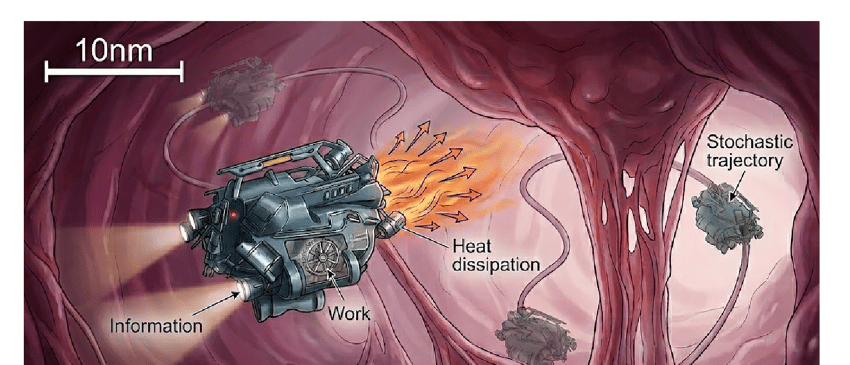
The original dream
A tiny machine converts fuel and information into useful work while dissipating heat along a fluctuating trajectory.
Success at small scales created today’s scaling questions.
Figure: Korbel et al. (2026), Fig. 1. Timeline synthesized from Sections 1 and 6.
Thermodynamics along individual trajectories
Complexity
Science✶Hub
✶
4
csh.ac.at ✶
A stochastic path and the experiment played backward
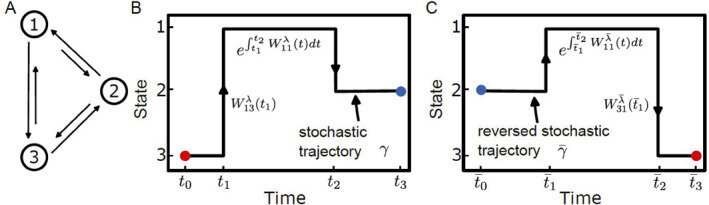
Forward path γ
Reversed path γ̄
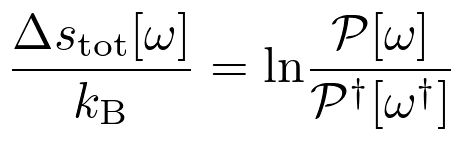
† means the reversed dynamics—and the reversed driving protocol when present.
What the equation compares
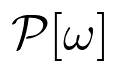
Probability of the observed forward trajectory
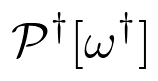
Probability under the physically reversed experiment
Local detailed balance
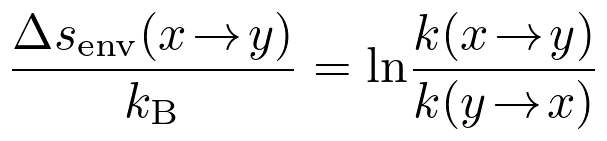
connects a transition-rate ratio to environmental entropy
Irreversibility is forward–reverse distinguishability. With complete microscopic dynamics and local detailed balance, it equals total entropy production divided by kᴮ.
Figure: Cao & Liang, Quantitative Biology 13, e75, doi:10.1002/qub2.75, Fig. 2. Relation: Korbel et al. (2026); Seifert (2005).
Microscopic foundations of stochastic thermodynamics
Complexity
Science✶Hub
✶
5
csh.ac.at ✶
At small scales, thermal fluctuations are comparable to internal energy changes
What microscopic resolution provides
Trajectory thermodynamics
Work, heat and entropy production can be assigned to each fluctuating realization, rather than only to an ensemble average.
Physical interpretation
Resolved states, transition rates and reservoirs let local detailed balance connect time asymmetry to dissipated heat.
Predictive constraints
Fluctuation theorems and universal tradeoffs constrain accuracy, current fluctuations and transformation speed.
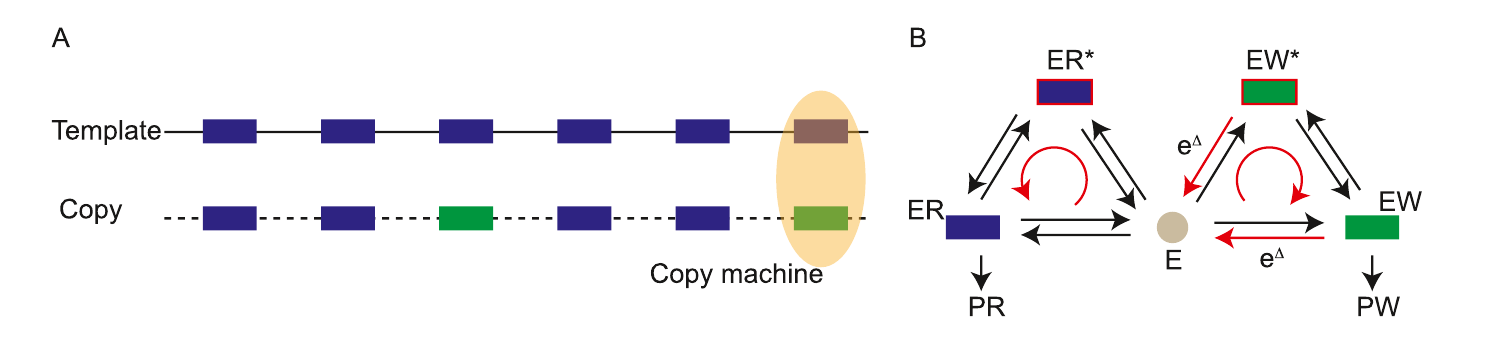
Microscopic example: Hopfield–Ninio kinetic proofreading

One driven proofreading stage doubles the discrimination exponent in the ideal limit. The gain requires chemical work, and approaching the error limit slows product formation.
Figure: Cao & Liang (2025), Fig. 5; Hopfield (1974). Context: Korbel et al. (2026), Sections 1 and 5.
Optimal transport and finite-time dissipation
Complexity
Science✶Hub
✶
6
csh.ac.at ✶
Moving probability farther and faster requires more dissipation
Redistributing probability
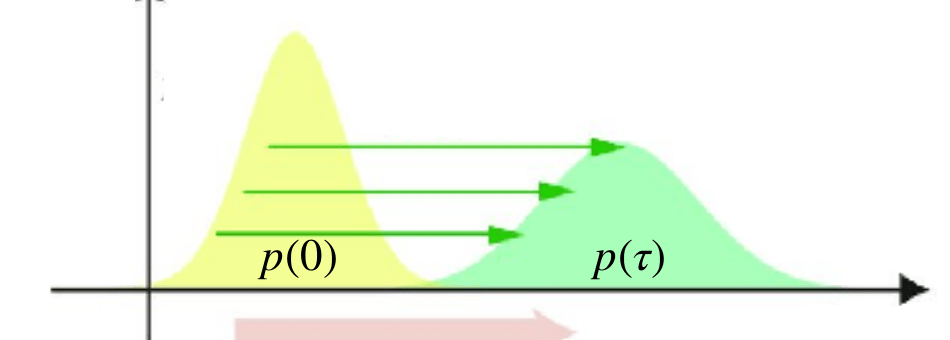
The initial distribution p₀ must be transported to pτ within the available time τ.
Wasserstein–2 transport cost

W₂ is the minimum quadratic cost of coupling the initial and final probability distributions.
Finite-time lower bound
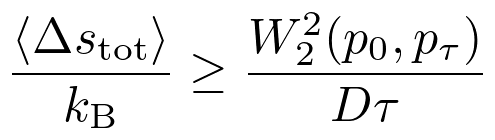
overdamped Langevin dynamics with constant diffusivity D
What optimal transport adds
The bound quantifies the unavoidable cost. The minimizing probability flow also identifies the least-dissipative protocol within the specified dynamical model.
Near equilibrium, Fisher geometry and thermodynamic length play the analogous role. Beyond overdamped diffusion, the appropriate transport geometry is not unique.
Korbel et al. (2026), Section 4; Aurell et al., J. Stat. Phys. 147, 487–505 (2012); Shiraishi et al., PRL 121, 070601 (2018).
Several geometries of dissipation
Complexity
Science✶Hub
✶
7
csh.ac.at ✶
Different dynamics induce different notions of distance and thermodynamic length
Near equilibrium
Overdamped diffusion
Beyond overdamped
Fisher metric

Thermodynamic length
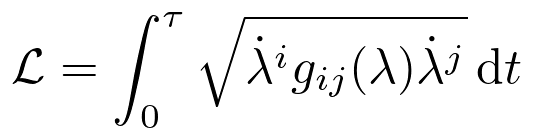
Controls excess dissipation for slow driving close to equilibrium.
Wasserstein–2

Quadratic transport length
The geodesic probability flow minimizes finite-time dissipation for overdamped Langevin dynamics.
Generalized transport

Wasserstein–1 and other costs
Jump processes, reaction networks and constrained dynamics can require a different cost and therefore a different geometry.
There is no universal thermodynamic metric: the dynamics determine the geometry.
Korbel et al. (2026), Sec. 4; Crooks (2007); Aurell et al. (2012).
Hidden variables create memory
Complexity
Science✶Hub
✶
8
csh.ac.at ✶
A Markov process can look non-Markovian when its state is only partially observed
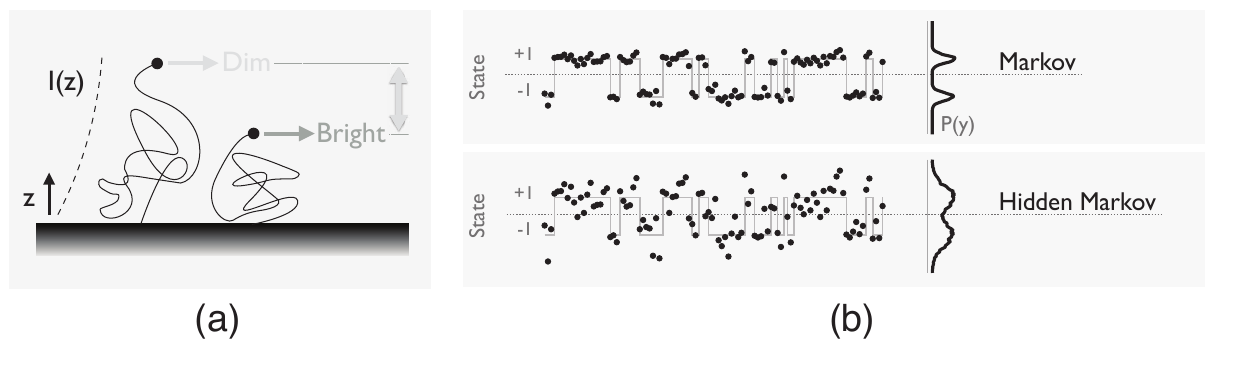
Why memory appears
The hidden state xₖ is Markovian.
The observation yₖ is noisy and incomplete.
Past observations help infer the current hidden state.
Observed irreversibility is a lower bound on the full entropy production

Equality requires local detailed balance and a complete thermodynamic state.
Approaches to hidden Markovian systems
infer lower bounds from partial time series
embed the dynamics in an enlarged Markovian state
formulate non-Markovian thermodynamics directly
Figure: Bechhoefer, New J. Phys. 17, 075003 (2015), Fig. 4. Framework: Korbel et al. (2026), Section 2.
Active and interacting matter
Complexity
Science✶Hub
✶
9
csh.ac.at ✶
Energy-consuming agents generate probability currents across scales
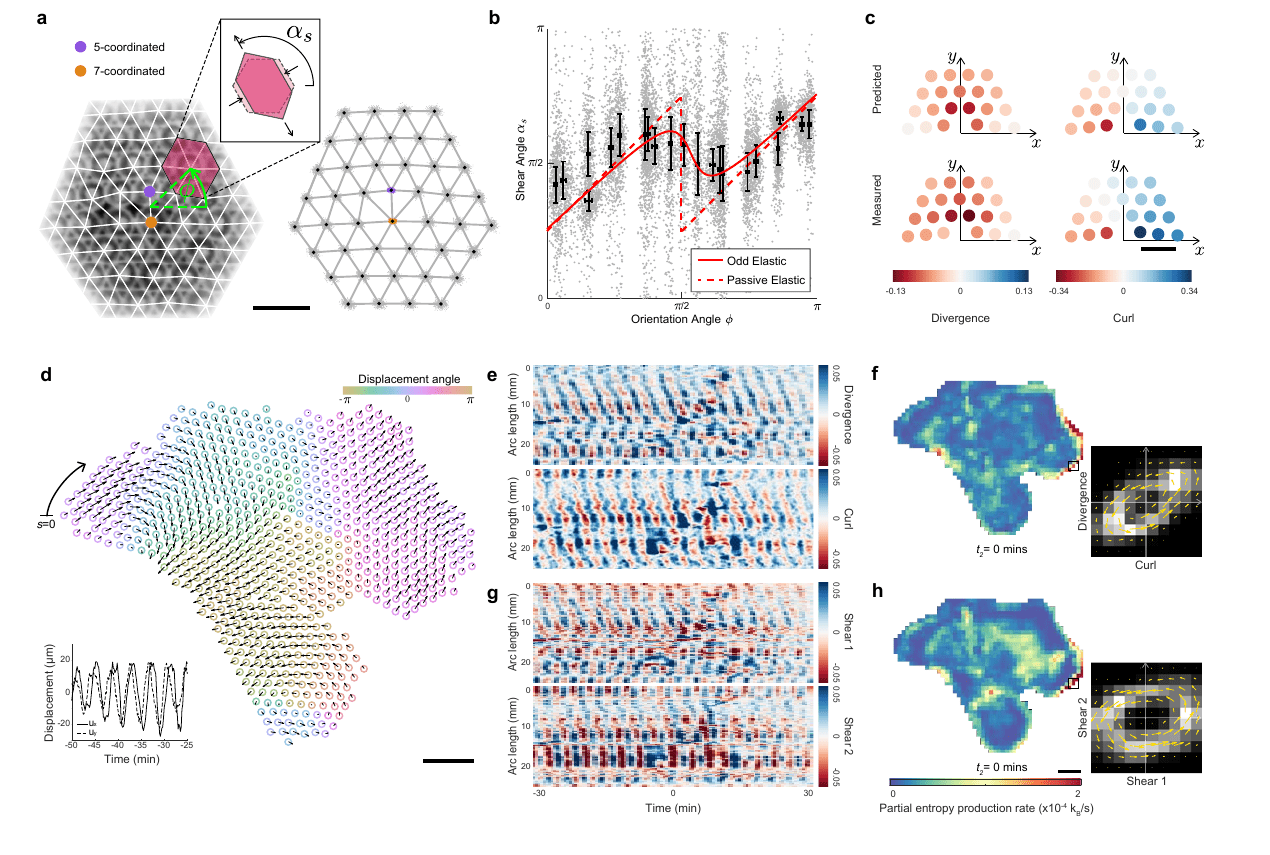
Key highlights from the Perspective
Currents are the signature

Fuel-driven currents reveal broken time reversal and may organize collective circulation.
Irreversibility is many-body

Doi–Peliti and Dean field theories retain interactions and multiplicative noise. Short-time terms set the rate.
A microscopic correlation rule

Pair interactions require three-point correlations. Short-range forces can reduce this to two-point form.
In the published figure, cycles in strain space yield probability currents and spatial maps of partial entropy production.
Figure: Tan et al., Nature 607, 287–293 (2022), Fig. 4. Framework: Korbel et al. (2026), Section 3.
The scaling wall
Complexity
Science✶Hub
✶
10
csh.ac.at ✶
Microscopic scale
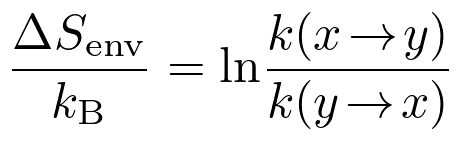
Local detailed balance links statistical asymmetry to physical dissipation
After coarse-graining
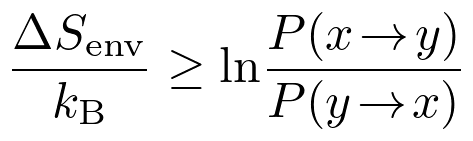
Hidden pathways are merged: data processing preserves only a lower bound, which can become extremely loose
Single transition
ATP hydrolysis
ΔSₑₙᵥ/kᴮ ≈ 10 to 20
Glucose oxidation
ΔSₑₙᵥ/kᴮ ≈ 1.2 × 10³
Coarse-grained observation
cytoskeleton
underestimate ≈ 10⁶
brain dynamics
underestimate > 10²⁰
Entropy production: physical cost requiring energies, reservoirs and local detailed balance
Irreversibility: forward–reverse distinguishability for any time series
Korbel et al. (2026), Section 5; Foster et al., PNAS 120 (2023); Lynn et al., PNAS 118 (2021).
A careful bridge to Active Inference
Complexity
Science✶Hub
✶
11
csh.ac.at ✶
An extension of the Perspective: connecting statistical boundaries with thermodynamic interpretation
Definition

Internal states μ and external states η become conditionally independent when the blanket B, formed by sensory states s and active states a, is known.
External world
η
Blanket B
Sensory s
retinal signals
Active a
muscle activity
Internal μ
neural states
→
→
←
←
observations
actions
Relation to stochastic thermodynamics

The blanket trajectory exposes only part of the full dynamics. Marginalizing hidden variables can only reduce measured time irreversibility.
Example: an embodied agent samples the external world through retinal signals and changes it through muscle activity; its neural states remain behind the blanket.
The inequality becomes a statement about physical dissipation only when a model identifies energies and reservoirs and satisfies local detailed balance.
Conditional independence specifies a boundary; energies, reservoirs and local detailed balance specify thermodynamics.
Markov-blanket definition: Parr, Da Costa & Friston, Phil. Trans. R. Soc. A 378, 20190159 (2020). Thermodynamic bound: Korbel et al. (2026), Sections 2 and 5.
Irreversibility beyond energetic models
Complexity
Science✶Hub
✶
12
csh.ac.at ✶
Forward–reverse asymmetry remains measurable even when no physical energy bookkeeping is available

Social dynamics
Opinion formation, imitation and collective decisions can show directional cycles and broken time-reversal symmetry.
Role: diagnose directional collective organization
Abstract computation
Logical or algorithmic state transitions have path probabilities, activity and timing—even before a hardware energy model is specified.
Role: formulate tradeoffs in information, time and activity
Biological & neural data
Brain states, disease markers and intracellular regulation can be classified by their degree and structure of time asymmetry.
Role: infer hidden nonequilibrium organization from data
What survives from stochastic thermodynamics
path probabilities · fluctuation relations · inference bounds · generalized resource tradeoffs
Without energies, reservoirs and local detailed balance, irreversibility is not a physical dissipation rate.
Korbel et al. (2026), Section 5 and outlook; statistical irreversibility is used here independently of an energetic interpretation.
Complexity
Science✶Hub
Limits define the frontier
Stochastic thermodynamics is becoming a framework for irreversibility, constraints and tradeoffs in complex systems.
Which thermodynamic structures survive coarse-graining?
Questions
CCS 2026: Quo vadis, stochastic thermodynamics
By Jan Korbel